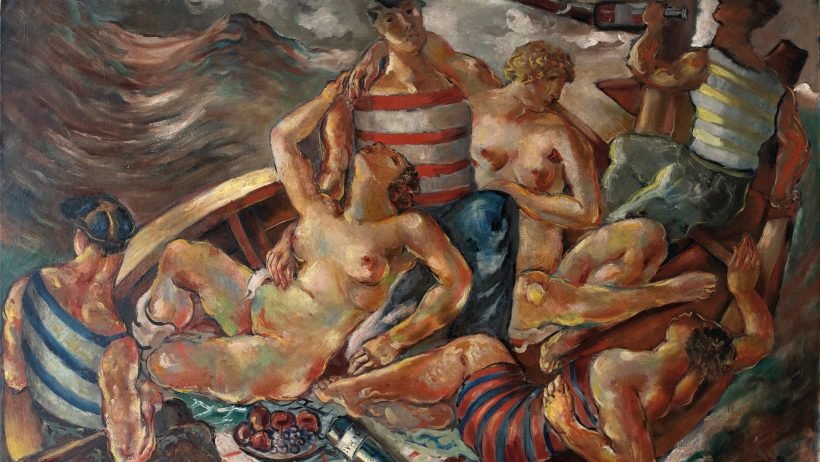
Time:
October 18, 2025 – March 1, 2027
Location:
Museum of Contemporary Art Belgrade
We mark a jubilee—60 years since the founding of the Museum—with the ceremonial opening of an exhibition of works from the collection.
Open to the public for the next two years, the exhibition inaugurates a new multi-year cycle through which the Museum will reaffirm the value of its collection across three major exhibitions, encompassing artworks created from 1900 to the present day.
The first segment of the cycle, Turning Points Toward Modernity: The Art of Society 1900–1945, offers a layered reading of the development of art in Serbia and Yugoslavia in the first half of the 20th century. Through more than 400 artworks by 150 artists, the Museum presents the collection not as a linear sequence of styles, but as a legacy that shapes our understanding of art and society.
The exhibition guides visitors through a series of carefully conceived chapters that connect chronological trajectories with phenomena and themes transcending a single era. The chronological thread runs from the first modernist breakthroughs at the turn of the century, through avant-garde experiments that opened new fields of expression, to the artistic practices of the 1930s that reflect social divisions, introspective questioning, and the era’s lyrical pursuits.
Parallel to this temporal path unfolds a thematic layer devoted to cultural and sociological phenomena—in which the city and civic identity assume the role of chroniclers of modernization—as well as to issues within artistic media: the portrait as the “face of an era,” movement as an exploration of form and the body, and sculpture and relief as investigations of spatial expression.
In this way, the exhibition reveals art not only as an aesthetic field, but also as a repository of political, social, and cultural change.
A special highlight of the exhibition is the series of mini-exhibitions Portrait of an Artist, presenting key figures of pre-war modernism (including Petar Dobrović, Sava Šumanović, Milena Pavlović Barilli, Ljuba Ivanović, Nadežda Petrović, Dušan Jovanović Đukin, Risto Stijović, and Sreten Stojanović).
The curatorial framework—signed by Mišela Blanuša, PhD Rajka Bošković, and Žaklina Ratković—conceives the collection as a form of dialogue between art and society, articulated through selected examples of the most significant works. In doing so, the Museum reaffirms both the value of its collection and its primary role in preserving and interpreting cultural heritage.
Writer. Blogger. Traveler. Researcher. Electronic Music Lover.