
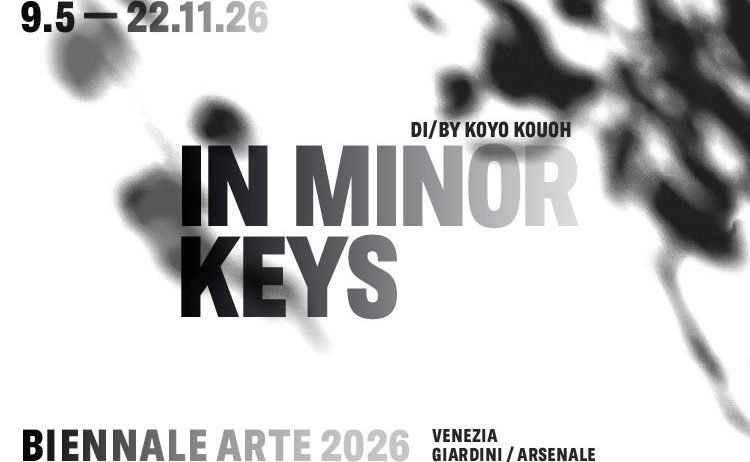
The 61st International Art Exhibition of Venice Biennale Arte 2026, titled In Minor Keys, will take place from 9 May to 22 November 2026 (preview: 6–8 May), across the Giardini, Arsenale, and multiple sites throughout Venice.
Conceived by the late curator Koyo Kouoh, the exhibition will be realized in full according to her vision, following her passing in May 2025. Developed before her death, Kouoh’s project already established its theoretical framework, artistic selection, spatial concept, and curatorial methodology, enabling the Biennale and her international team to carry forward her work as both exhibition and legacy.
A Relational and Collective Curatorial Practice
At the core of In Minor Keys lies a curatorial approach grounded in relationships, dialogue, and shared authorship. The exhibition emerged through an intensive collaborative process, culminating in a key gathering in Dakar at RAW Material Company—an institution founded by Kouoh—where conceptual directions, motifs, and structural pillars were collectively shaped.
This process reflects Kouoh’s methodology:
not a fixed curatorial narrative, but a living constellation of practices, affinities, and encounters, evolving across geographies and disciplines.
A Global Constellation of Artistic Practices
The exhibition brings together 111 participants, including artists, collectives, and artist-led organizations from diverse global contexts. Rather than organizing them into rigid thematic sections, Kouoh envisioned a relational geography, connecting practices across cities such as Dakar, Beirut, Salvador, San Juan, Paris, and Nashville.
This approach emphasizes:
- resonance over categorization
- simultaneity over hierarchy
- connection over separation
Motifs Instead of Themes: A New Exhibition Grammar
Instead of traditional curatorial sections, In Minor Keys unfolds through a series of conceptual motifs, forming a fluid, non-linear exhibition structure:
- Shrines – tributes to artists such as Issa Samb and Beverly Buchanan, emphasizing art as a generative, living force beyond objecthood
- Processions – inspired by Afro-Atlantic gatherings and carnivals, activating collective movement and participation
- Schools – artist-centered ecosystems rooted in learning, autonomy, and social responsibility
- Oases / Rest – spaces for contemplation, reconnection, and multisensory immersion
These motifs are drawn from practices that engage both mind and body, allowing the exhibition to function as a compositional experience rather than a didactic display.
Between Memory, Ecology, and Rest
The exhibition navigates complex terrains, including:
- colonial histories and plantation systems
- environmental and geological transformations
- collective memory and trauma
At the same time, it introduces spaces of rest, regeneration, and non-human coexistence, such as gardens and courtyards—both real and metaphorical—positioned as sites of resilience and autonomy.
Through multisensory installations, visitors are invited into states of rêverie, enchantment, and deep listening, stepping away from the encyclopedic logic of large exhibitions.
Performance and the Body as Knowledge
Performance plays a central role, framing the body as a carrier of memory, resistance, and healing. A key moment will be a poetic procession in the Giardini, inspired by Kouoh’s Poetry Caravan (1999), honoring oral traditions and collective storytelling.
Exhibition Design as Threshold Experience
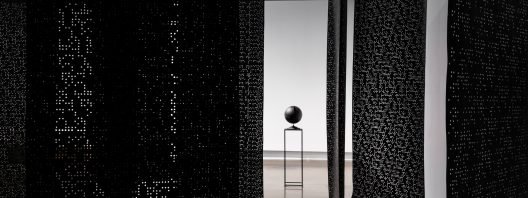
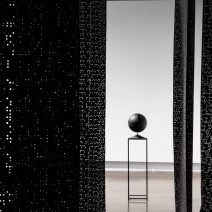
Designed by Wolff Architects, the scenography emphasizes the threshold as a spatial and symbolic device—a passage between states of perception. Indigo banners and fluid transitions structure the visitor experience, creating moments of pause and sensory recalibration between artistic “constellations.”
Sustainability and Carbon Responsibility
In parallel with its curatorial vision, La Biennale di Venezia continues to implement a long-term sustainability strategy aimed at reducing the environmental impact of its events.
Since 2021, the Biennale has restructured its operations according to established sustainability principles. Between 2022 and 2024, it achieved carbon neutrality certification (PAS 2060), while for 2025, it pursued carbon footprint calculation in line with ISO 14067 standards across all activities.
A key insight is that visitor mobility represents the largest share of the Biennale’s carbon footprint, prompting renewed efforts in 2026 to raise public awareness and encourage more sustainable travel behaviors.
Concrete measures include:
- use of renewable energy
- reduction, recycling, and reuse of materials and exhibition structures
- optimization of logistics and transport
- promotion of locally sourced food and vegetarian options
- adoption of low-impact mobility solutions
The Biennale remains committed to reducing emissions under its control and offsetting residual emissions through certified carbon credits, positioning itself as a leading example of environmentally responsible large-scale cultural production.
A Biennale of Subtle Power
In Minor Keys, ultimately proposes a radical yet quiet shift:
from spectacle to attunement, from scale to sensitivity, from production to relation.
It is an exhibition that does not seek to dominate attention, but to transform perception—inviting audiences to rediscover the world through listening, connection, and care.

Writer. Blogger. Traveler. Researcher. Electronic Music Lover.